12 March 2007

Power Spots

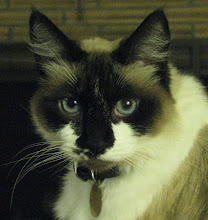
Cats have an innate ability to track where we humans focus our attention, and an uncanny knack for interposing themselves between us and there. (Sometimes, I suspect, levitation is involved.) The goal, of course, is to reassert themselves as the center of the universe and the sole purpose of our existence.

This is a big "duh," but I thought it worth documenting, especially since Stella Luna and China Rose recently provided such textbook examples. I post these shots knowing that you might never (again) accept a cup of coffee, let alone a meal, at my house.

Cats and quilts, especially quilts in progress, are another manifestation of the same phenom. The attraction is almost magnetic.

But books and newspapers are the classic example of the feline ability to find the power spot. Abbie, not pictured, is a master at getting between me and whatever I'm trying to reading. He's on my lap, on my laptop, even as I type. Years ago, a friend postulated that cats can read, and that they have a specialized eye for this purpose located somewhere near their anus. That would explain it.

08 March 2007

Red and White

The lawn in front of Eliot Hall at Reed is covered with small flags. At first glance, it looks like a dusting of snow. On second look, you can discern scattered concentrations and dots of red.

Each of the 112,000 white flags represents six Iraqis who died in the Iraq war. Each of the 3,000 or so red flags stands for a dead American soldier.

At the edge of the lawn are bundles of additional flags; a sign invites you to plant some of your own.

Red and white make pink. My first camellia blossom is out. Spring is stirring in Portland, and that obscene war goes on.


05 March 2007

Dyeing the way you live

I spent most of the weekend at the Oregon College of Arts & Crafts, immersed up to my elbows in Judilee Fitzhugh's workshop on one-pot natural dyeing. "One-pot" means that the entire process -- cooking up the dyestuff (usually plant material), mordanting, and dyeing -- happens in the same pot. It's easier and less messy, in some ways, than Procion (tm) dyeing, and generally less toxic, though it takes more prep and the results are less predictable. The leaves, stems and flowers of the same plant might all yield different colors; time of year and water source figure in as well.

A mordant, for those of you who haven't been hanging out around the dyepots, is a substance that helps bind the dye to the fabric (though not all dyestuffs require the extra help). Simply using an aluminum, copper or iron pot will often provide enough mordant to do the job. We used powdered alum, as well as a copper vat and a nicely-rusting iron pot. Different mordants skew the results toward darker or brighter shades; iron, for instance, "saddens" or grays the color. (This process goes back to medieval times, and some of the terminology, wonderfully, does, too.)

An amazing array of vegetable matter will yield worthwhile dyes. Queen Anne's lace, dahlias, daffodils, rhododendrons, manzanita and madrone are all good dyestuffs. There are dozens of books on the subject; I picked up a lot of information (some of it contradictory) browsing through Judilee's collection. You can dye with turmeric, saffron or annatto -- which has been moldering in my spice collection for years -- rhubarb leaves, which are poisonous when ingested, red cabbage, spinach or chard, and of course coffee grounds or old, cold tea. Hey, throw it in your dye vat before you put it in your compost bin!

For the workshop, though, we used three colorific crowd-pleasers that come pulverized and pre-packaged: osage orange, logwood and brazilwood. They tend toward yellow, purple and red, respectively. We also stewed up some walnut hulls (brown) and a mess' o' Japanese knotweed (red-brown). I even brought in some of those hateful spiky seedballs from my sweetgum trees, hoping to find some redeeming value in them. Nah.

Judilee mixed up some freeze-dried indigo, by popular request, just to have on hand. The proximity of a vat of indigo, ready to go, is very alluring, and I ended up with more blue fabric than I'd intended. We also used the indigo to overdye some of our yellows to a lovely green. Ironically, despite the grass-stained clothing of our childhood, not many dye plants yield a good clear green.

There were only three of us in the workshop, me and two women named Amy, which made it easy for Judilee; she already knew me, so everyone else had to be Amy. A class this small gave us all room to experiment, ask questions and compare results, and made it so much less of a hassle to find space to work and to hang dripping pieces of fabric. And it was quiet. It felt luxurious. On Friday in particular, when it rained hard all day, it was lovely to stand over a steaming dye vat, thinking that I had nothing to do at that particular moment other than what I was already doing.

Anyway, we dyed a variety of silks, from organza to dupioni (yum), plus some wool that I'd bought at Mill Ends and shared around (that's the wool hanging to dry in my laundry room at home). I dyed the rest of the cream-colored, rose-patterned damask tablecloth that I used last year in my Mom Quilt. One of the Amys brought in hemp, which took the dye well, too. By the end of the class, each of us had an enviable stash of fabrics in a range of gorgeous, lush colors, as well as some yarn and thread that we'd wound and dipped, plus a few skeins that Judilee had prepared for us.

Weeks ago, when I registered for the workshop, I couldn't see myself stewing up vatfuls of miscellaneous stalks and stems on my own stovetop, but I figured that this would be a good opportunity to find out what natural dyes were all about. The workshop not only met my expectations, it fired my imagination. I am my mother's Saran-Wrap-washing daughter, after all, and the idea of using stuff that's free for the picking, pruning or scavenging is very appealing. Plus there's the hippie granola Berkeley/Portland sustainability thing -- reduce, re-use, recycle -- which has been part of my psyche, if not always my practice, ever since I can remember. So I came home yesterday and ordered two natural dyeing books. Now I'm eyeing my rhododendrons.

28 February 2007

New and Used

I've been wanting to blog for the last few days but, aside from quick trips to Gig Harbor and Berkeley to visit old friends and intentional family, life's been fairly uneventful.

I have accomplished a lot on the domestic front, including hiring a gardener/landscaper to help me turn our scrabbly front lawn into a thing of beauty, and contacting an accountant to get our taxes done (Thanks to Libbi for both referrals). The ever-practical Jer pointed out that it would make sense, before spending megabucks on landscaping, to have the sewer line, which runs under the lawn, inspected. So I set up a sewer-scoping appointment; the guy came out the next day and gave our pipe a clean bill of health, yay.

See what I mean? Uneventful. There is one bit of real news: We finally have neighbors next door, a couple from San Francisco. That's kind of a big deal, since the house has been vacant since we moved here more than a year and a half ago. We're looking forward to having them over for a drink and a schmooze.

I'd also jotted myself a note to say something about the two CDs that haven't been out of my changer since I bought them, except for the few minutes it took to load them onto my iPod: John Callahan's (yes, the outrageous cartoonist) Purple Winos in the Rain, and Casey Neill's Memory Against Forgetting. I hadn't heard of Casey til he blew us away at WinterFolk with a flawless and powerful mix of protest, punk and Celtic (generally not all in the same song). Great set, great singer-songwriter. R-Bob sez check 'em both out.

This morning I heard an NPR interview with Susan Patron, who wrote The Higher Power of Lucky, a Newbery Medal-winning children's book that's set off a huge brouhaha in library-land because it uses the word "scrotum." According to the author, this isn't the first work of juvenile fiction in which the word appears. But "scrotum" is right there on page 1, and the Newbery is the kiddy-lit version of the Nobel Prize for Literature, so no wonder the issue's held sway (I can't resist) in the media, including the New York Times' semi-clueless take. I'll spare you my own further thoughts, since I'm sure the library blogosphere is abuzz with opinions more fact-based than my own.

But books and, I suppose, scrota, were on my mind as I walked up to Reed this afternoon. I was headed for New and Used, the current exhibit in the Cooley Gallery. The photographer, Marc Joseph, takes as his theme old books and records and the stores that sell them. The images are large-scale, color, evocative. Several were very compelling, as was the turntable set up in the middle of the gallery -- Nico's Chelsea Girl was playing when I walked in -- with another half dozen LPs (The Mekons, Sonic Youth, Patti Smith) on a shelf below, and a sign inviting visitors to bring in albums of their own and play them at a respectful (I think that was the word) volume. There was also a bench and a browsing copy of the much-more-than-an-exhibit-catalog, full of essays about old books and bookstores and record-collecting, that sucked me in immediately. I meandered over to the campus bookstore to buy a copy. "How's it going?" asked the clerk. "Very self-indulgently," I replied, as I handed over $45. I'm sure the call to publish in hardcover was a medium-as-message decision on the artist's part; the book as artifact, and all that. Good for him.

As I left the bookstore, headed for home, a glint in an archway caught my eye; another Reedie art project. Ten or so metallic silver-blue objects, ranging from in-your-dreams life-sized to the dimensions of a 30-gallon Hefty bag, all hanging in the breeze, gently swaying. Male-italia. Ball sacks. Scrota. Sometimes life is just too congruent for words.

22 February 2007

The Man Who Talks to Crows

Jerry typically carries a small supply of dog biscuits when we go for a walk. Lately, he's been feeding more crows in the neighborhood than dogs.

He's developed a little routine, a line of patter to attract the corvoid flocks: "Look, Mr. Crow! Yo! Pay attention! Here you go!" As if they needed to be told.

Some are a bit leery, waiting til we're well down the block before cautiously approaching the fragments of Milk-Bone (tm) scattered on the sidewalk. Others are downright bold, swooping over our heads and landing right behind us to feed the moment we walk away.

I think we've officially joined the ranks of eccentric but basically harmless retired people. In fact, I know it. Apparently the crows do, too.

11 February 2007

Road Trip, Sky Trip

It's been a busy couple of days. I finally made it down to Coos Bay, with my friends Beth and Mary, to see a pair of art quilt exhibits, Speaking in Cloth and Fine Focus '06, at the museum there. Mary's husband Farley drove, and we made a two-day art tour of it, taking in the Coos Bay art walk (such as it was) on Thursday night and some galleries in Eugene en route home on Friday, after breakfast at the excellent Zenon Cafe.

Speaking in Cloth was co-curated by two local textile artists, Jeannette DeNicolis Meyer (with whom I've studied) and Ann Johnston, and includes their work and that of four other artists. Fine Focus consists of small works (no more than a foot or so on a side) by 50 different artists. Both were inspirational in the very direct sense of making me want to get back into my studio and create.

Apart from the art, the Coos Art Museum has, in its lobby, the largest angelwing begonia plant I've ever seen. A typical leaf was six or seven inches long, about the size of an entire plant, in my experience. As I was oohing and aahing over it, the volunteer receptionist pressed a cutting on me, which of course I had to baby for the rest of the trip. I'll try to make a good home for Little Bertha.

Speaking of large plants, we called in a tree guy to prune some low and otherwise iffy limbs from the two sweetgums on our parking strip. Most of the work happened before I got home on Friday. It sure makes a big difference; lots more light in the living room, for one thing -- and, I hope, fewer of those hateful spiky seedpod balls to deal with during the fall and winter. We also gained some firewood, which Jer toted around back and I spent an hour or so stacking. Yes, I did ache the next day.

The city is still offering free aerial tram rides on Saturdays during February, so yesterday we decided to check it out. The new tram connects the South Waterfront area with the OHSU (Oregon Health & Science University) complex on Marquam Hill. It was a controversial project for all the obvious reasons -- cost, neighborhood impact, and so on -- but, from what I've read, it's quieter and less obtrusive than originally feared, and most of the neighbors seem to have made their peace with it. The line was long-ish, with lots of kids and a definite Disneyland vibe. It moved quickly, though, since the ride is just three minutes long and each of the two cars (cabins? capsules? gondolas?) holds more passengers than you might imagine.

The view en route is spectacular, and the structure itself a gorgeous piece of engineering. I took the equivalent of two rolls of film and posted a bunch on Flickr. At the top, we strolled along the observation deck, which is studded with sculpture. The adjacent corridor is hung with some interesting paintings and prints. Who knew? Obviously we'll have to add another stop to our standard tour-guide itinerary: "We'll take you to the Japanese Garden, the Rose Garden, the Classical Chinese Garden, Powell's Books, and then we'll go to the hospital."

05 February 2007

Dealing with those UFOs (UnFinished Objects)

At long last, I finished the 4-year-old quilt top I blogged about on 25 January (following the rhapsody on Jerry's cooking). Jer saw an infinity sign in it, so I decided to orient it horizontally and call it "Infinite Africa." I used some metallics, and quilted it pretty heavily throughout. It's roughly 2 x 3 feet in dimension. Above is the whole quilt; the other pic is a detail.

I ran out of binding fabric but pieced in some similar-feeling ethnic material, which looks okay and actually adds, I think, to the energy of the piece. Then I remembered that, when I picked up this project to complete it several weeks ago, I'd cut and pressed more than enough of the original binding fabric and set it aside in a Zip-Loc. Damn. Sometimes I'm too efficient for my own good.

Incidentally, I realized that I'd never photographed, for the record, a small (maybe 18 inches square) Hawaiian applique and hand-quilted piece that was my constant companion for many months'-worth of Monday Quilting (my small group in California) meetings. Nothing says "I'll always have something to work on while I'm schmoozing" like needle-turned applique and contour quilting. The background is my own hand-dye; the applique is commercial batik.

Anyway, as soon as I finished "Africa," I went back to "Occasional Sunbreaks," the paean to Portland winters that I described in my 12 December post. I finally figured out how to deal with loopy stitches on the back by tightening the top tension much, much more than I'd ever dared before. I also got to the point of grokking what that slick, silky-finish thread (some Mettler, some Sulky, some Superior), and even some metallics, really want, needle-, tension- and sewing-speed-wise, to be happy. Here's a shot of the entire piece, which measures about 25" wide by 27" high, plus details of the four main blocks. There are some pins around the edges because the binding isn't yet sewn down in back. Also quite a bit of cat hair that I'll brush off when it's really, truly finished and ready to hang -- at which point it'll collect ambient cat hair from the atmosphere, like everything else in this house.